Why AI Agents Fail in Production: 10 Engineering Failure Modes (2026)
AI agents often work beautifully in demos and fail under real production conditions. Learn 10 practical failure modes across tools, memory, evals, security, observability and recovery—and the engineering patterns that make agents more reliable.
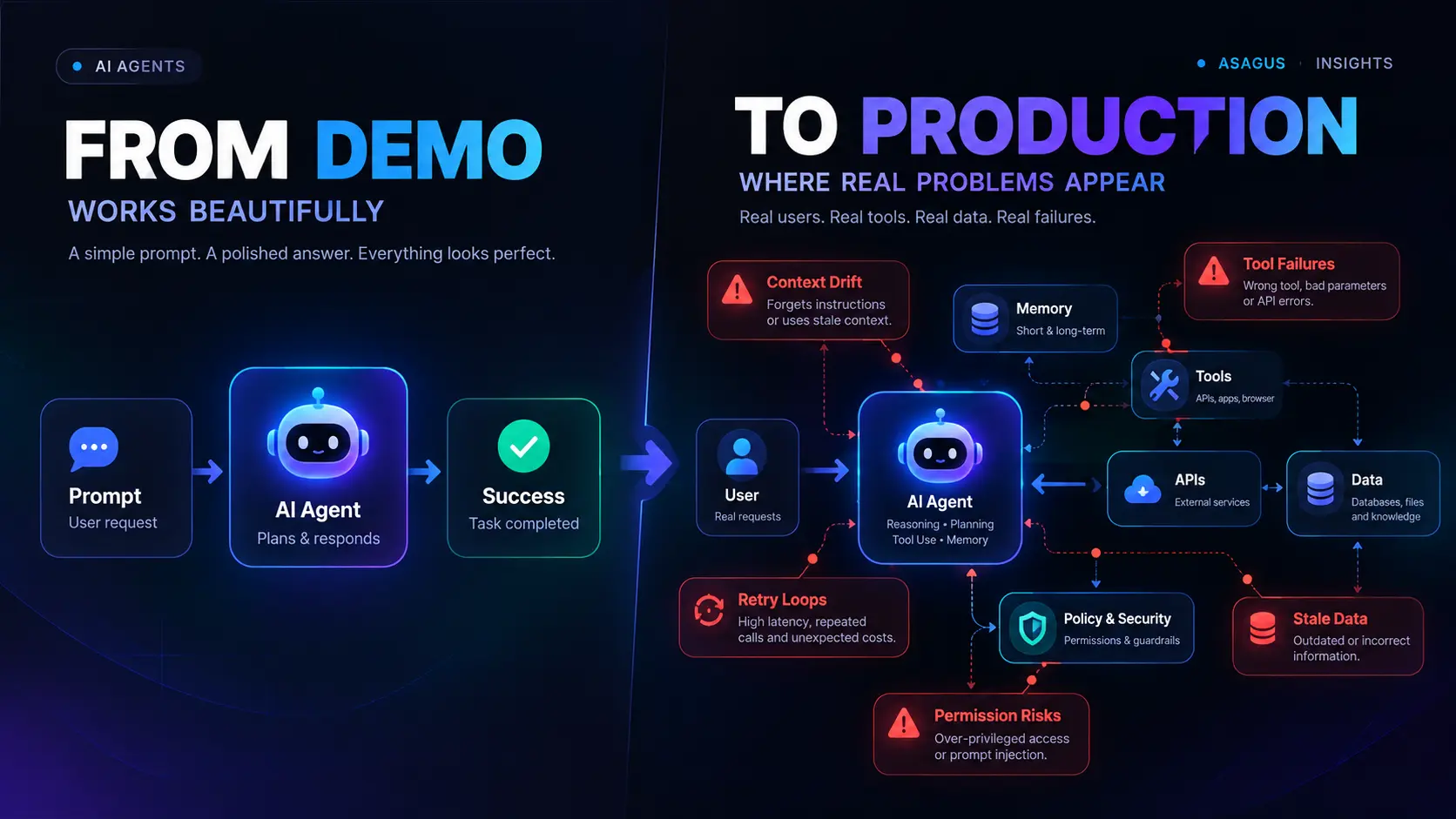
AI agents are remarkably easy to demo and surprisingly difficult to operate.
A prototype can browse a website, call an API, update a record, draft an email and return a polished answer in under a minute. Run the same system thousands of times against real users, unreliable APIs, changing data, long conversations and sensitive permissions, however, and an entirely different engineering problem appears.
This is why AI agents often fail in production even when the underlying model is capable. The failure is usually not one dramatic hallucination. It is a chain of smaller problems: an ambiguous tool call, stale context, a retry that fires twice, a missing evaluation, an over-privileged credential, or an agent that confidently reports success when the real-world action never happened.
The practical lesson for 2026 is simple: a production AI agent should be engineered less like a chatbot and more like a distributed system containing a probabilistic decision-maker.
Quick answer
AI agents fail in production when teams optimize the model but under-engineer the system around it. The recurring failure modes are compounding errors across long tasks, unreliable tool execution, weak success criteria, context and memory degradation, missing observability, uncontrolled retries and costs, excessive permissions, unsafe side effects, brittle integrations and cascading multi-agent failures. Reliable systems constrain these risks with evals, explicit state, strict tool contracts, tracing, budgets, idempotency, least privilege, checkpoints and human approval for high-impact actions.
Why a successful demo proves less than you think
A demo asks a narrow question: can the agent complete this task at least once?
Production asks a much harder question: can the agent complete the right task consistently, on messy inputs, while tools fail, permissions remain constrained, costs stay predictable and every important action remains auditable?
Those are not the same benchmark.
Research on tool-using agents has highlighted the difference between one successful run and repeated reliability. An agent may demonstrate that it can perform a task while remaining inconsistent when the same workflow is executed repeatedly. Long-horizon tasks create an additional problem: every dependent step gives the system another opportunity to drift, misread state or propagate an earlier mistake.
A useful reliability intuition
If a hypothetical 20-step workflow had a 95% independent success probability at every step, the probability of all 20 steps succeeding would be only about 36%. Real agent errors are often correlated, so this simplified calculation can be optimistic rather than pessimistic.
That is why production readiness is not achieved by swapping in a slightly smarter model. Reliability has to be designed around the model.
The 10 AI agent failure modes that matter in production
Failure modeWhat users seeEngineering response1. No measurable definition of successA polished answer is treated as a completed taskOutcome-based evals and independent verification2. Compounding multi-step errorsLong workflows degrade unpredictablyReduce steps, checkpoint and verify intermediate state3. Unreliable tool executionWrong tool, wrong parameters or duplicate actionStrict schemas, validation and idempotency4. Context and memory degradationThe agent forgets constraints or trusts bad memoryExplicit state, provenance and memory lifecycle5. Observability blind spots“Success” in logs but wrong business outcomeEnd-to-end traces and business outcome checks6. Retry loops, latency and cost runawaySlow runs, repeated calls and surprise billsBudgets, stop conditions and circuit breakers7. Excessive permissions and prompt injectionA bad instruction becomes a real actionLeast privilege and policy enforcement outside the model8. No durable execution or safe recoveryA crash restarts or duplicates completed workCheckpointing and replay-safe actions9. Integration and data driftThe agent is logical but operates on stale realityContract tests, freshness checks and dependency health10. Multi-agent cascading failuresOne bad assumption spreads across several agentsTrust boundaries, narrow roles and circuit breakers
1. The agent has no measurable definition of success
The most dangerous production failure can look completely healthy.
An agent returns a polished message saying that the task is complete. Its internal workflow reports success. No exception was thrown. But the support ticket was never created, the CRM record contains the wrong customer ID, or the refund API returned an error that the agent summarized away.
The underlying problem is that the team defined success as “the agent produced a good response” instead of “the intended business outcome happened correctly.”
A production evaluation should therefore exist at more than one layer:
Did the final answer satisfy the task?
Did the agent choose the correct tools?
Were the arguments valid?
Did the real-world side effect actually occur?
Did the workflow obey security and approval rules?
Could the same task succeed consistently across repeated runs?
Production symptom: high apparent completion rate but growing manual corrections or customer complaints.
Engineering fix: maintain a representative eval dataset, score both outcomes and trajectories, and turn every important production failure into a regression case.
Monitor: verified task-success rate, human correction rate, failed outcome checks and regression score by agent version.
2. Small errors compound across long workflows
An agent does not usually execute one action. It creates a plan, gathers information, calls tools, interprets results, updates state and decides what to do next.
That flexibility is useful, but it creates a reliability chain. A subtly incorrect assumption in step three can become accepted state in step four and a confident decision in step eight.
This is especially dangerous because downstream reasoning can remain internally coherent. The final answer may be beautifully structured while being based on a wrong value introduced ten minutes earlier.
The goal is not to pretend the model will never make a mistake. The goal is to stop one mistake from controlling the rest of the run.
Break long tasks into explicit phases.
Checkpoint important state after each phase.
Verify high-impact intermediate outputs before they become trusted inputs.
Prefer deterministic code for deterministic decisions.
Escalate when required information is missing instead of forcing the agent to guess.
Production symptom: short tasks work while longer runs fail unpredictably.
Engineering fix: shorten the decision chain, validate intermediate state and create explicit recovery points.
Monitor: success rate by workflow length, failure position, number of model/tool steps and percentage of runs requiring recovery.
3. Tool calls fail in ordinary software-engineering ways
Tool calling is where an AI agent stops being a text generator and starts changing the world.
The model might call the wrong function, provide a malformed argument, use the correct API with the wrong customer ID, retry a request that already succeeded, or continue after receiving a partial result.
None of these failures requires a spectacular hallucination. They are normal integration failures made more difficult by a probabilistic caller.
A production tool interface should therefore be intentionally boring:
Use strict schemas and narrow parameter types.
Reject unknown fields rather than silently accepting them.
Keep tool names and descriptions unambiguous.
Separate read and write operations.
Validate arguments again immediately before execution.
Return structured errors the agent can interpret.
Use idempotency keys on operations that may be retried.
If a human engineer could plausibly confuse two tools from their descriptions, the model can too.
Production symptom: correct intent, wrong action.
Engineering fix: treat every tool as a typed production API, not as a natural-language suggestion.
Monitor: tool selection accuracy, schema validation failures, retry rate, latency and side-effect duplication.
If your agents use external tools through MCP, our Model Context Protocol guide explains how clients, servers, tools and data boundaries fit together.
4. More context is not the same as better context
Long context windows can create the illusion that memory management has been solved.
It has not.
A long-running agent accumulates user messages, retrieved documents, tool outputs, intermediate summaries, system constraints and previous decisions. Even when all of that technically fits inside the model's context window, the information can become noisy, contradictory or difficult to retrieve reliably.
Persistent memory adds a second problem: bad state can survive the original interaction. A false assumption, malicious instruction or outdated preference can be written once and influence future sessions.
Production memory should have structure:
Separate temporary working state from durable memory.
Store provenance with important facts.
Classify memory by trust level.
Expire stale state when appropriate.
Treat memory writes as privileged operations.
Do not automatically treat retrieved text as an instruction.
Production symptom: the same agent becomes less reliable during long sessions or behaves incorrectly because of old context.
Engineering fix: deliberately construct context instead of continuously accumulating it.
Monitor: context size, retrieval relevance, memory write volume, age of retrieved state and failures correlated with long sessions.
5. You cannot operate an agent you cannot reconstruct
Traditional application monitoring often asks whether a request returned an error.
An AI agent can fail while every request returns HTTP 200.
It can choose the wrong tool, misunderstand a tool result, consume excessive tokens, skip an approval step and still return a valid-looking final response.
Production observability therefore needs the execution trajectory, not just the final response.
A useful trace should answer:
Which model calls happened?
Which tools were selected?
What arguments were passed?
What did each tool return?
Where did retries occur?
How many tokens and how much latency did each step consume?
Did the real-world outcome match the agent's reported outcome?
Tracing also creates the raw material for better evals. A surprising production failure can be captured, understood, converted into a regression case and tested against future versions.
Production symptom: “We know the answer was wrong, but we cannot explain why.”
Engineering fix: instrument the full agent trajectory from day one.
Monitor: cost per successful outcome, tool latency, tool-error rate, retry count, step count and disagreement between self-reported and independently verified completion.
6. Unbounded retries turn failures into latency and cost incidents
Agents are persistent by design. A tool fails, so the model tries again. A result looks incomplete, so it searches again. A plan does not work, so it creates another plan.
Persistence becomes dangerous when the system has no budget.
A transient API error may deserve a retry. An authorization failure probably does not. A semantic mistake should rarely be retried five times with essentially the same plan.
Every production run should have explicit ceilings:
Maximum model calls.
Maximum tool calls.
Maximum retries per dependency.
Maximum wall-clock duration.
Maximum token or monetary budget.
Explicit conditions that stop and escalate to a human.
Circuit breakers are equally useful. If a downstream system is failing repeatedly, the agent should stop hitting it and move into a known degraded mode rather than adding more traffic to an already failing dependency.
Production symptom: p95 latency suddenly climbs or cost per task rises while overall traffic stays similar.
Engineering fix: hard budgets, bounded retries, timeouts, backoff and circuit breakers.
Monitor: cost per successful task, retries per run, p50/p95 latency, loop depth and sessions terminated by a budget limit.
7. Prompt injection becomes more dangerous when the agent can act
A chatbot that follows a malicious instruction may produce a bad answer.
An agent with access to email, files, CRM records, payment systems or deployment tools can turn the same failure into a real side effect.
The dangerous pattern is to give the model broad permissions and then rely on the system prompt to tell it what not to do.
Security policy should be enforced outside the model.
Give every tool the minimum permission necessary.
Separate read access from write access.
Treat external documents, websites, emails and tool outputs as untrusted data.
Validate actions against deterministic policy before execution.
Require explicit approval for irreversible or externally visible actions.
Bind approval to the exact action and parameters.
Keep credentials outside model context whenever possible.
OWASP's 2026 agentic security guidance formalizes several related risks, including goal hijacking, tool misuse, identity and privilege abuse, memory poisoning and cascading failures.
Production symptom: the agent performs a technically authorized action that was never intended.
Engineering fix: least privilege, trust boundaries and an execution policy layer independent of the LLM.
Monitor: denied tool calls, privilege boundary violations, approval frequency, injection alerts and unusual write activity.
For systems that expose tools through MCP, this security model becomes particularly important. Our ChatGPT MCP app guide covers the architecture behind tool-connected AI applications.
8. A production agent needs durable execution, not just conversation memory
Imagine an agent that completes 17 steps, updates two systems and then crashes while waiting for a third API.
What happens next?
If the only state is in process memory or a conversation transcript, restarting may mean rerunning the entire workflow. That can repeat emails, duplicate database writes or trigger the same external side effect twice.
Durable workflows instead persist meaningful state as the run progresses and make side effects replay-safe.
Checkpoint after important steps.
Persist tool results that should not be recomputed.
Resume from known-good state after failure.
Use idempotency keys for retried side effects.
Separate workflow state from conversational memory.
Production symptom: a restart creates duplicate work or loses completed progress.
Engineering fix: durable state plus idempotent external actions.
Monitor: resumed workflows, duplicate-action prevention, checkpoint age and recovery success rate.
9. The agent can reason correctly about stale or broken reality
A perfectly functioning model cannot compensate for a broken data pipeline.
Production integrations change. Tokens expire. API schemas evolve. A column is renamed. An index stops updating. A downstream service begins rate limiting. A vendor returns partial data.
The agent may continue reasoning over those inputs without understanding that the world underneath it has changed.
Treat every integration as a monitored dependency:
Validate schemas.
Track data freshness.
Run synthetic tool-call checks.
Version critical tool contracts.
Expose dependency health to the orchestrator.
Fail explicitly when required data is stale or unavailable.
Production symptom: traces look normal but decisions are based on incomplete or stale data.
Engineering fix: monitor the information supply chain, not only the LLM.
Monitor: data freshness, schema violations, tool uptime, authentication failures and stale-index age.
10. Multi-agent systems can multiply errors faster than capability
Adding more agents can be useful when work can genuinely be decomposed.
It can also create more coordination surfaces, more state, more tool calls and more opportunities for one agent's incorrect assumption to become another agent's trusted instruction.
A planner may create a subtly wrong task. A researcher completes that task perfectly. A writer summarizes the result. A final agent validates formatting but not the original premise.
Every component worked. The system failed.
Multi-agent architecture should therefore be earned rather than assumed:
Use one agent when one agent is enough.
Give specialized agents narrow responsibilities.
Validate messages crossing trust boundaries.
Avoid unnecessary shared mutable state.
Create explicit termination conditions.
Use circuit breakers between high-impact stages.
Evaluate the whole workflow rather than assuming good component scores add up to a good system.
Production symptom: individual agents appear healthy while end-to-end reliability worsens.
Engineering fix: reduce unnecessary coordination and enforce trust boundaries between agents.
Monitor: handoff failures, repeated work, message validation failures, task graph depth and end-to-end success versus component success.
What a production-ready AI agent architecture actually needs
Framework choice matters less than whether the surrounding architecture contains the controls required to survive failure.
LayerResponsibility1. Input boundaryAuthentication, validation, injection handling and scope2. Agent / plannerReasoning, decomposition and tool selection3. Policy and execution gatewayPermissions, approvals, schema validation, budgets and tool execution4. Durable stateCheckpoints, memory, provenance and recovery5. Observability and evaluationTracing, outcome verification, cost monitoring and regression evals
A model should be able to propose actions. It should not be the only component deciding whether sensitive actions are allowed to execute.
The production checklist we would use before increasing autonomy
The task has a measurable definition of success.
A representative eval set exists before launch.
Important production failures become regression tests.
Tool schemas are narrow and machine-validated.
Every write action is explicitly distinguishable from a read.
Retries are bounded.
Side effects are idempotent where possible.
Workflow time and cost budgets are enforced.
Long-running workflows checkpoint durable state.
Memory entries have scope and provenance.
External content is treated as untrusted.
Tools receive least-privilege credentials.
High-impact actions require parameter-bound approval.
Every run can be traced end to end.
Business outcomes are verified independently of agent self-report.
Downstream dependencies have health and freshness checks.
A degraded mode exists for important dependency failures.
There is a kill switch for runaway or unsafe execution.
Incident traces can be preserved for investigation.
The autonomy level is justified by measured reliability, not by the quality of the demo.
When you should not build an autonomous agent
Not every AI workflow benefits from more autonomy.
If the sequence of steps is known in advance, a deterministic workflow with one or two carefully placed model calls is often easier to test, cheaper to run and safer to operate.
Use an agent when the task genuinely requires dynamic decisions, flexible tool selection or adaptation to information that cannot be predicted upfront.
A simpler workflow is often preferable when:
the process has a fixed sequence;
the cost of a wrong action is high;
inputs and outputs are highly structured;
deterministic validation can solve most of the problem; or
human review is required regardless of agent confidence.
The objective is not to maximize autonomy. It is to use the minimum autonomy required to create useful business value.
A better mental model: assume the agent will eventually be wrong
Reliable production systems are not built by assuming every component will always behave perfectly.
Databases time out. Networks partition. APIs rate-limit. Users provide unexpected inputs. Processes crash.
AI agents add another failure source: a probabilistic component that can make a plausible decision that is still wrong.
The correct response is not to remove the probabilistic component. It is to place it inside an architecture that assumes failure and contains the blast radius.
That means checkpoints instead of hope, policy instead of prompt-only restrictions, outcome verification instead of self-reported success, and traces instead of trying to reproduce a stochastic failure from memory.
Final take
The difference between an impressive AI agent demo and a production AI agent is not primarily the model.
It is the engineering surrounding the model.
Production agents need measurable evals, constrained tools, explicit state, reliable integrations, durable execution, full tracing, bounded cost, security controls and a clear path to human intervention.
The model should be allowed to reason where reasoning creates value. Deterministic systems should enforce the rules that cannot be probabilistic.
That is how an agent moves from “it worked in the demo” to “we can trust this workflow to run every day.”
If your team is moving an AI workflow from prototype to production, ASAGUS builds AI and machine-learning systems, secure integrations and production automation. Discuss the workflow with us before increasing autonomy—the safest architecture is often decided before the first production agent is deployed.
Sources & References
- Anthropic — Demystifying evals for AI agents Anthropic · Official Documentation
- Anthropic — Building Effective AI Agents Anthropic · Official Documentation
- OpenAI — Evaluate agent workflows OpenAI · Official Documentation
- OpenAI — Integrations and observability OpenAI · Official Documentation
- OpenAI — Agents SDK OpenAI · Official Documentation
- OWASP — Top 10 for Agentic Applications 2026 OWASP · Official Documentation
- OWASP — LLM Top 10 2026 OWASP · Official Documentation
- OpenTelemetry — GenAI Observability OpenTelemetry · Official Documentation
- METR — Task-Completion Time Horizons METR · Official Documentation
- τ-bench — Tool-Agent-User Interaction Benchmark τ-bench · Official Documentation